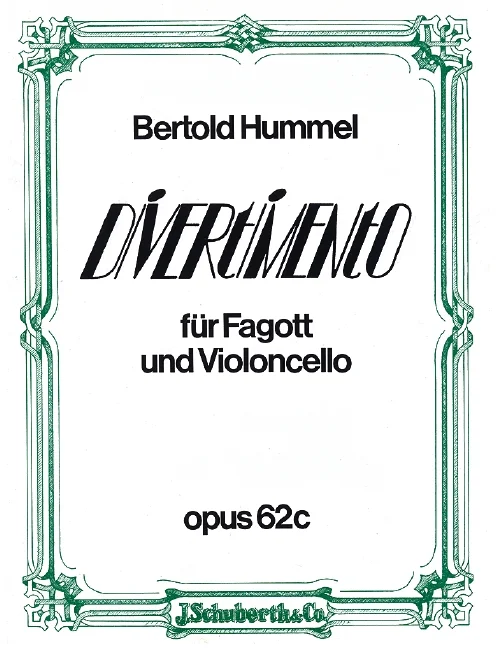
Divertimento for bassoon and violoncello (op. 62c, 1977)
I. Prologue, II. Intermezzo, III. Waltz, IV. Introduction and March
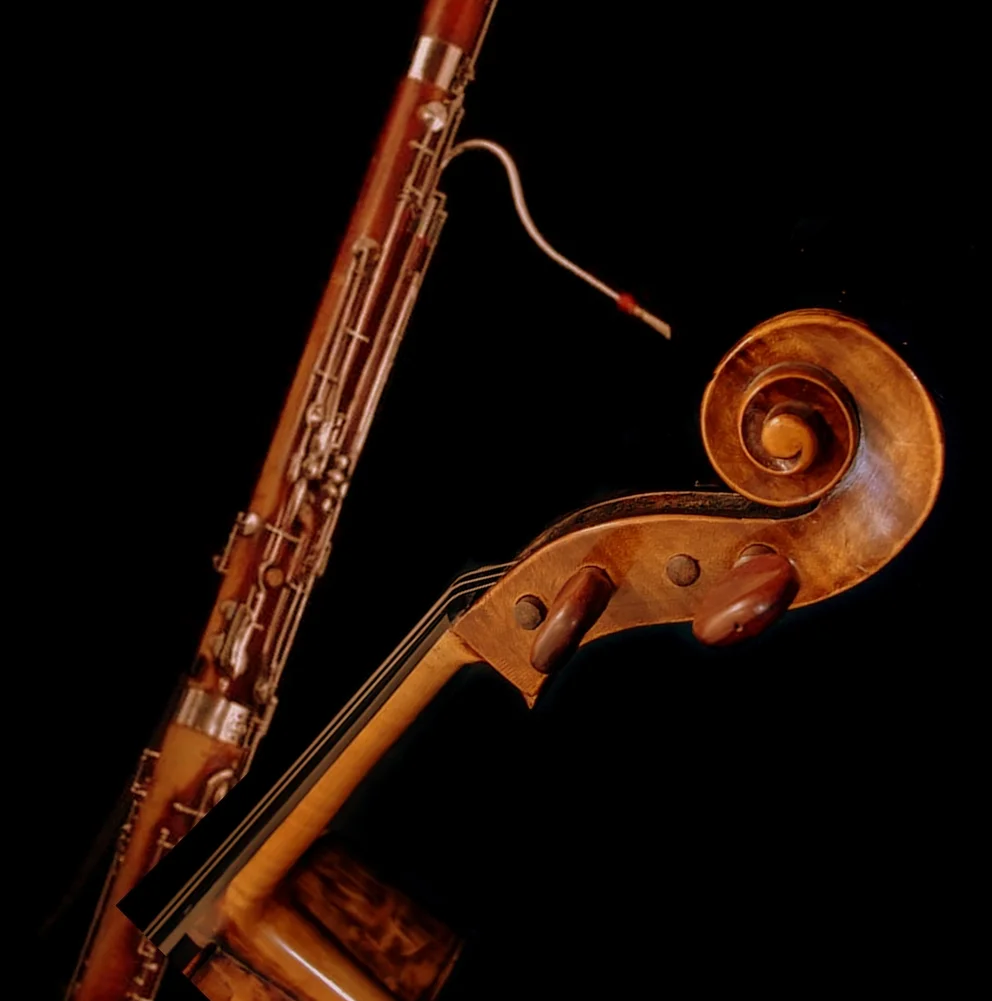
bassoon, cello
Duration: 10 minutes
Matthias Maria Scholz | Monika Schwamberger
Title: Divertimento for bassoon and violoncello (1977) (edited after the Div. f. E.H. u. Vla.) - Length: 14 pages - Date: 22.9.76 Edited 12.77 after the Div. f. E.H. u. Vla - Location: Bayerische Staatsbibliothek Munich
A tonally witty dialogue for bassoon and violoncello became a delicious New Year's Eve gift. In a pathetic dialogue, followed by a musical dispute and a merry waltz, the composer invites us to an optimistic march into the New Year. The applause confirmed that Hummel was not playing past the listeners.
In 1981, Schuberthverlag Hamburg published Bertold Hummel's Divertimento for bassoon and violoncello op. 62c, which was written in 1977 and arranged by the composer in the published instrumentation from a model for cor anglais and viola (incidentally an occasional composition as a serenade for a wedding of two musician friends).
As there is unfortunately still very little literature for this instrumentation, this composition is certainly an enrichment in terms of its musical quality. This charming chamber music is a moderately difficult musical work, which was not written from a compositional theory, but rather by a composing instrumentalist for the respective instrument and its characteristic features and is therefore also ideally suited for chamber music instrumental lessons.
Based on concise short motifs, which were arranged by the composer in four quite contrasting movements - quasi in serenade style - tonal formulations and turns of phrase are not dispensed with despite the free tonal structure. Bertold Hummel's tonal reference to Genzmer and Hindemith is audible and the four movements are divided into a vocal prologue, a motoric-musical intermezzo, a playful, charming waltz, an expressive introduction and an energetic march.
The composer Bertold Hummel has been President of the University of Music in Würzburg since 1979. Within the wide range of his works, this composition reveals the composer's versatility. This divertimento was recorded by the bassoonist Eberhard Buschrnann and Bertold Hummel (cello) at Bayerischer Rundfunk.
Alfred Rinderspacher
Hummel's four movements for bassoon and violoncello, an instrumentation almost exclusively used by Mozart, exude a brilliant musical mood and a great deal of humour: tailor-made for the sound and expressive character of the instruments, musical and lively (Stravinsky seemed to be the inspiration for the final march), the composition found excellent interpreters in Matthias Maria Scholz and Monika Schwammberger.